Signs Your Composite Deck Needs Resurfacing in Desert Heat: A Repair-First Guide
Your composite deck was supposed to be the low-maintenance option. Then ten Henderson summers hit it, and now the boards look chalky, the color is uneven, and a few planks feel soft near the edges. Before you assume you need a full rebuild, or start pricing deck refinishing services near you, walk through this diagnosis first. Most sun-damaged decks in the Las Vegas Valley need a targeted fix, not a teardown, and the difference between those two answers is thousands of dollars.
This guide takes a repair-first approach on purpose. A deck builder who defaults to "rip it out and start over" is selling you a project, not solving your problem. The honest path is to check the structure first, then the surface, then decide between repair, resurfacing, and replacement based on what you actually find.
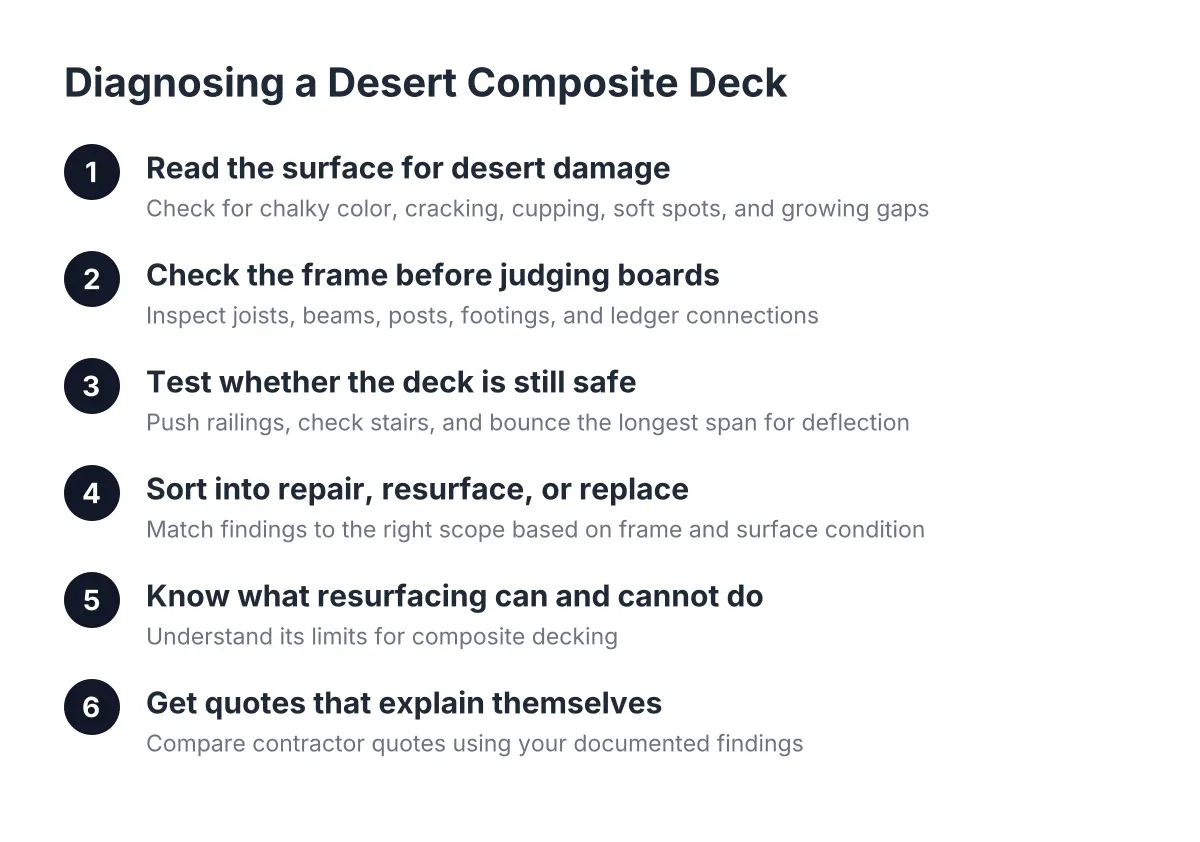
Step 1: Read the Surface for Desert-Specific Damage
Start with what the Mojave sun does to composite decking, because it fails differently here than it does in wetter climates. You are not looking for rot from rain. You are looking for UV breakdown and heat stress.
Walk the deck in the morning before the boards heat up and check for these signs:
- Chalky or faded color. Older composite boards lose their pigment under constant UV exposure. If a hidden section under a planter still shows the original color, the difference tells you how much the sun has taken.
- Surface cracking or checking. Fine cracks along the board face mean the cap layer or surface resin is breaking down. Water and dust work into those cracks and speed up the damage.
- Cupping and warping. Boards that curl up at the edges or bow across their length have been through too many expansion cycles. Desert heat swings, hot afternoons followed by cool nights, stress fasteners and board edges more than most homeowners expect.
- Soft or spongy spots. Press near board ends and around fasteners. Older uncapped composites can absorb moisture from irrigation overspray and degrade from the inside.
- Gaps that grew. Composite expands and contracts with temperature. If gaps between boards look uneven or fasteners have backed out, the surface has been moving.
Take photos of everything you find. You will want them when you compare quotes later, and they help a contractor give you a straight answer instead of a vague one.
Step 2: Check the Frame Before You Judge the Boards
Get under the deck, or at least look along the outside edge, and inspect the structure. This step decides everything. Surface damage with a solid frame means resurfacing is on the table. A failing frame means resurfacing would be wasted money.
Look for these problems in the joists, beams, and posts:
- Cracked or split joists, especially where boards attach
- Rusted joist hangers or corroded fasteners
- Posts that have shifted, tilted, or pulled away from footings
- Ledger board connections at the house that look loose or gapped
In addition, pay attention to footings. Henderson yards often sit on hard caliche layers and expansive desert soils, and footings that were poured shallow or undersized can shift over time. A deck that feels bouncy or leans slightly usually has a foundation problem, not a board problem.
If you find structural damage, stop here and bring in a professional. Frame and footing repairs affect safety, and in Clark County they can also trigger permit requirements. This is the one point in the process where a DIY judgment call is not worth the risk.
Step 3: Test Whether the Deck Is Still Safe to Use
Answer the "is my deck safe" question with a simple hands-on check. Grab the deck railing and push hard in both directions. Any movement beyond a slight flex means the railing posts or their connections need attention, and loose railings are the most common failure point on decks past the ten-year mark.
Next, check stairs. Stringers crack, treads loosen, and connections at the top of the stairs take more load than any other part of the deck. Then bounce lightly in the center of the longest span. Noticeable deflection points to undersized or damaged joists.
For example, say a Henderson homeowner is prepping a house for sale and the buyer's inspector flags a wobbly railing and two cracked boards. That is a repair-scope job, likely in the low thousands, not a replacement. However, if the same inspection finds a pulled ledger connection, that moves the project into structural territory and the budget conversation changes.
Step 4: Sort Your Deck Into Repair, Resurface, or Replace
Match what you found in Steps 1 through 3 to one of three paths. This is where a repair-first mindset saves you money, because each path costs meaningfully more than the one before it.
Repair fits when damage is isolated: a handful of warped or cracked boards, loose fasteners, a wobbly railing section, or worn stair treads. Deck board replacement costs stay manageable when the frame is sound, since a crew is swapping individual planks rather than rebuilding anything.
Resurfacing fits when the surface is failing broadly but the frame passed inspection. The crew removes all the decking and railing, inspects and reinforces the joists, and installs new boards on the existing structure. For a composite deck with widespread fade, cracking, and cupping, this is usually the sweet spot. You get a new deck surface at a fraction of full deck replacement cost because the framing, footings, and often the railing posts stay.
Replacement fits when the frame or footings failed inspection, when the deck was underbuilt for its current use, or when you want a different footprint anyway. If you are already dreaming about a bigger outdoor living space, a patio cover, or a hot tub deck, replacement may be the honest recommendation even from a repair-first builder, because resurfacing a frame you plan to change makes no sense.
There is a resale angle here too. In the 2025 Zonda Cost vs. Value Report, a composite deck addition recoups 89% of its cost at resale. A well-executed resurface protects that value for far less than a rebuild.
Step 5: What Deck Refinishing Can and Cannot Do for Composite
Understand one distinction before you buy products or book a service: traditional deck refinishing, meaning sanding and restaining, is a wood-deck process. You cannot sand a capped composite board without destroying its protective layer, and most composite manufacturers void warranties if you try.
For composite decks, "refinishing" realistically means three things:
- Deep cleaning. A proper wash with a composite-safe cleaner removes years of desert dust, mineral spotting from irrigation, and surface grime. On lightly faded decks, this alone can restore a deck's appearance more than owners expect.
- Specialty coatings. Some deck refinishing products are formulated to recoat older, uncapped composite boards. They can buy a few years on a structurally sound deck, but they are a maintenance commitment, not a permanent fix, and results on heavily degraded boards are mixed.
- Resurfacing with new boards. When cleaning and coating cannot fix cracking or cupping, replacing the deck surface is the durable answer. Modern capped composite and PVC boards handle UV far better than the first-generation composites installed 10 to 15 years ago, and heat-reflective options run cooler underfoot, which matters when Henderson deck surfaces get too hot for bare feet.
The trade-off is honest but real: coatings cost less now and less later per application, while resurfacing costs more up front and then asks almost nothing of you for years. If you plan to stay in the home, resurfacing usually wins the math. If you are selling next season, a deep clean and targeted deck repair and resurfacing of the worst boards may be the smarter spend.
Step 6: Get Quotes That Explain Themselves
Ask every contractor to separate their quote into structure, surface, and railing. A single lump-sum number tells you nothing about whether they inspected the frame or just measured the deck from the yard. As a result, you cannot compare a lump-sum quote against an itemized one, and vague quotes are how deck repair costs balloon after work starts.
A useful quote for this kind of project should spell out:
- What the frame inspection found, in writing
- Which boards or sections are being repaired versus replaced
- The specific board product and color, since UV performance varies by line
- Whether railing posts are reused or replaced
- Any permit or HOA design-review steps, common in Henderson master-planned communities
Therefore, treat the quote conversation as a second inspection. A deck builder who walks the frame, photographs problem areas, and explains why resurfacing beats replacement, or the reverse, is showing you how they will run the whole job. One who quotes deck refinishing costs per square foot without ever looking underneath is guessing with your money.
Start with the diagnosis, not the estimate. In desert heat, composite decks age in predictable ways, and most of what looks like a dying deck is a tired surface on a healthy frame. Fix what is actually broken, resurface what is actually worn, and save the rebuild budget for the day you genuinely need it.
If you need deck construction, Henderson Deck Co can help.
Prefer to talk it through? Call (725) 425-5179 — a quick call is usually the fastest way to get a straight answer for your situation.