Caliche Footings: Why Desert Decks Fail in Henderson and How to Fix Them
If your deck in Henderson is sagging, wobbling, or pulling away from the house, there is a good chance the problem starts below the boards, not on top of them. Caliche footings on desert decks behave differently than footings anywhere else in the country, and when they were dug wrong or set shallow, the whole structure moves. The good news: most of these failures can be diagnosed and repaired without tearing out the entire deck. Understanding the signs of caliche footing failure is essential before you decide whether repair, resurfacing, or rebuild makes sense. Learning to recognize caliche footing failure signs allows you to evaluate whether your problem is cosmetic or structural before choosing between repair, resurfacing, and rebuild without defaulting to the most expensive option. This guide walks you through how caliche affects deck footings, and how to choose between repair, resurfacing, and rebuild without defaulting to the most expensive option.
That repair-first approach matters even more if you are planning to put a hot tub on the deck. A filled spa concentrates thousands of pounds on a small footprint, and footings that were fine for patio furniture may not be fine for a spa. We will cover that case specifically, because it is the one where guessing wrong costs the most.
What Caliche Is and Why It Matters for Deck Footings
Caliche is a hardened layer of soil cemented together by calcium carbonate, and it sits under much of the Las Vegas Valley, including Henderson. Locals call it desert concrete for a reason. It can be nearly as hard as actual concrete, and it often sits in irregular layers, so one footing hole hits it and the one next to it does not.
For deck construction, caliche cuts both ways. A footing that bears on solid caliche sits on one of the most stable bases you could ask for. The layer resists settling and does not shrink or swell much with moisture the way clay soils do.
However, the problems show up when the original builder took shortcuts. Digging through caliche is slow, loud work that often requires a jackhammer or a demolition breaker instead of a standard auger. A crew pricing a fast job has an incentive to stop digging when they hit the hard layer, pour a shallow pad on top of loose fill, and move on. That shortcut is the root cause behind many failing desert decks.
There is a second failure mode that surprises homeowners. Caliche does not drain. Water from irrigation, a pool deck, or a rare heavy monsoon can perch on top of the caliche layer and sit against the footing and post base. Over years, that trapped moisture rots wood posts at the ground line and corrodes cheap hardware, even in a climate where everything else stays bone dry.
Recognizing Caliche Footing Failure Signs: The Patterns Behind Desert Deck Problems
Most deck failures in the Henderson area trace back to one of four causes, and you can learn to spot the difference between them. Knowing which one you have determines whether you need a few hundred dollars of repair or a structural fix.
Shallow footings resting on fill instead of caliche
When a footing stops short of the hard layer, or sits on loose fill that was dumped over caliche during home construction, it settles. The symptom is a deck that slopes toward one corner, posts that have sunk below their original height, or gaps opening between the deck and the house. Settling in desert soil tends to happen early, then slow down, so a deck that moved in its first few years may be stable now. A deck that is still moving needs attention.
Moisture trapped above the caliche layer
Look at the base of each post. Soft, punky wood at ground level, white mineral crust on concrete, or rusted post bases all point to water perching on the caliche and wicking into the structure. This is common near pools, spa drains, and drip irrigation lines. The deck surface can look fine while the posts holding it up are failing from the bottom.
Sun damage that looks structural but is not
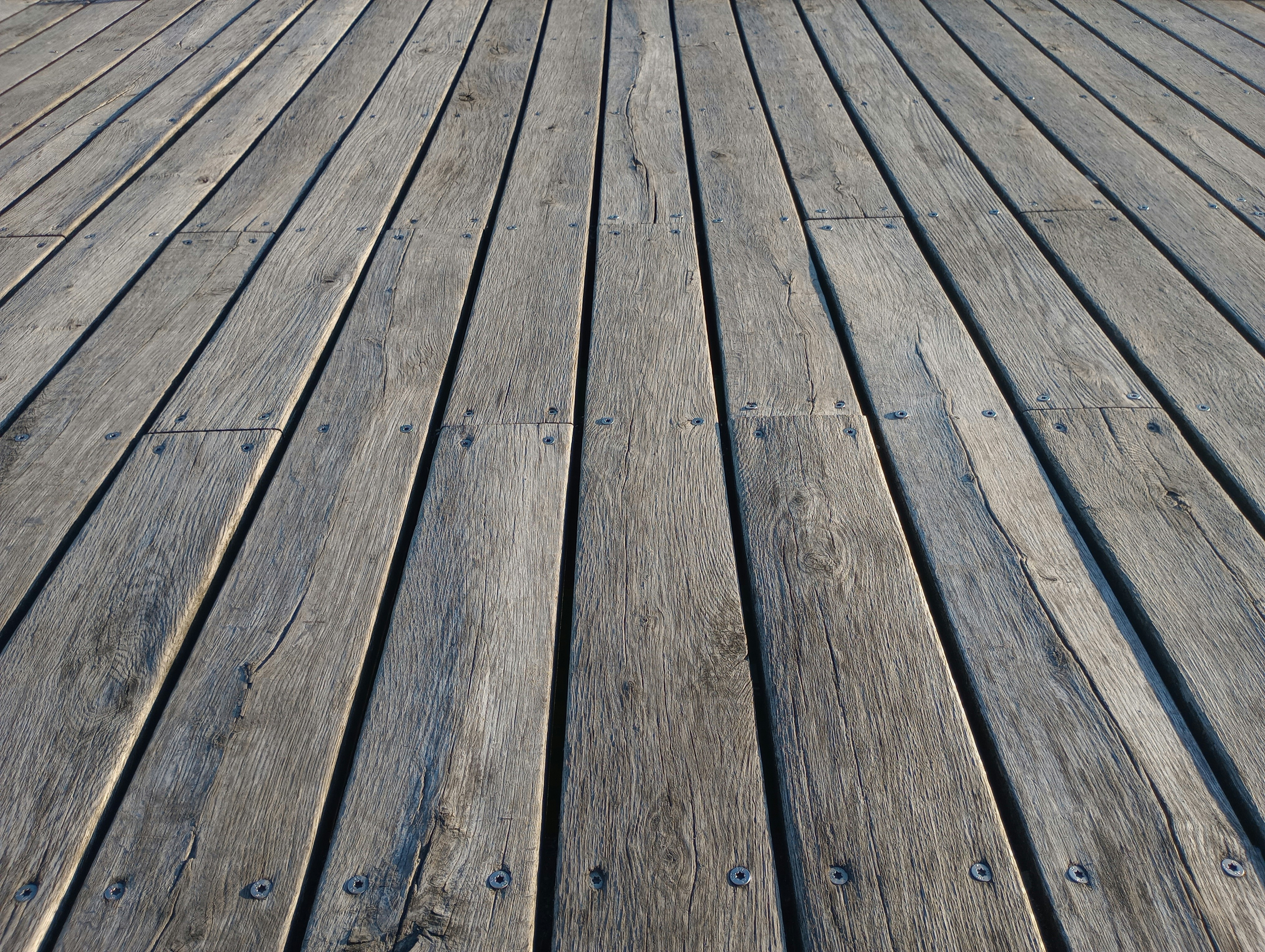
Mojave sun is brutal on deck surfaces. UV breaks down wood fibers, which leads to gray, cracked, splintering boards and warped deck boards that cup and lift at the edges. Homeowners often see this and assume the deck is done. In many cases the framing underneath is sound, and the fix is deck board replacement or resurfacing, not a rebuild. Surface damage and structural damage are different problems with different price tags.
Undersized framing asked to do a new job
The fourth pattern is a deck that was built correctly for its original use and is now being asked to hold something heavier, most often a hot tub. Nothing failed; the requirements changed. This is a reinforcement project, and we will cover it in detail below.
Is My Deck Safe? A Homeowner's Diagnostic Walkthrough
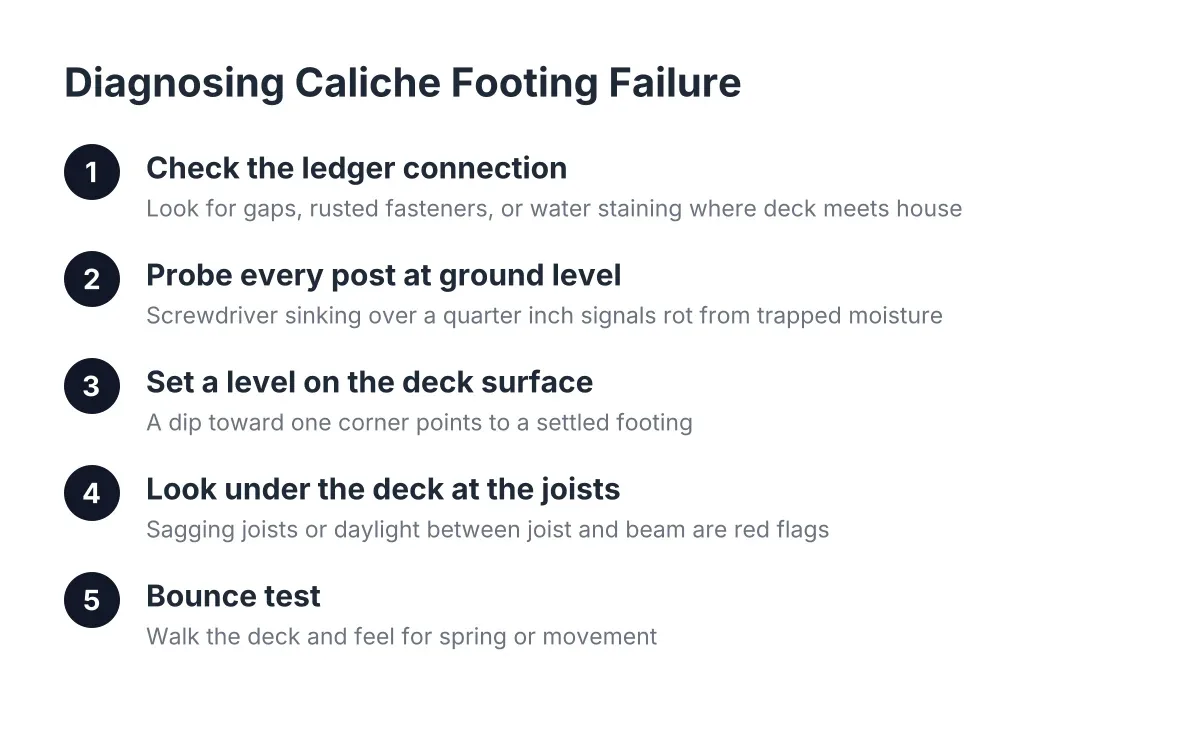
You can learn a lot about your deck's condition in thirty minutes with a flashlight, a screwdriver, and a level. Work through this checklist before you call anyone, so you can describe what you are seeing in specific terms.
- Check the ledger connection. This is where the deck attaches to the house. Look for gaps, rusted fasteners, or water staining. Ledger failures cause most deck collapses, so any movement here means stop using the deck and get a professional evaluation.
- Probe every post at ground level. Push a screwdriver into the wood where the post meets soil or concrete. If it sinks in more than a quarter inch with light pressure, the post is rotting from trapped moisture.
- Set a level on the deck surface in several spots. A consistent, slight slope away from the house is intentional drainage. A slope toward one corner, or a visible dip around one post, points to a settled footing.
- Look under the deck at the joists. Checking, which is lengthwise cracking from sun and dryness, is normal in older wood. Sagging joists, split ends at the hangers, or daylight between joist and beam are not.
- Bounce test. Walk the deck and feel for spring or sway. Solid framing feels dead underfoot. Movement means loose connections, undersized members, or footing problems.
- Inspect the railings. Grab each railing post and push hard. Any wobble is a safety issue, though usually an inexpensive one to fix with proper deck railing hardware.
If the surface is ugly but the framing passes these checks, you are likely a candidate for deck repair and resurfacing rather than replacement. That distinction is worth real money, which is the next topic.
Repair, Resurface, or Rebuild: Making the Call Honestly
The honest answer most Henderson homeowners never hear: the substructure and the surface fail on different schedules, so you should evaluate them separately. Pressure-treated framing protected from ground moisture can outlast two or three deck surfaces. Paying for a full rebuild because the boards look bad is like replacing a car because the paint faded.
Here is how the three options break down.
Repair makes sense when the problems are localized. A few rotted boards, one settled footing, loose railing posts, or corroded hangers can each be fixed individually. When you observe caliche footing failure signs and diagnosis reveals a single failed footing, repair typically means excavating beside the failed footing, breaking down to or through the hard layer, pouring a proper new footing, and transferring the load with new post hardware. It is disruptive for a day or two, not a rebuild.
Resurfacing fits when the framing is sound but the surface is sun-beaten across the whole deck. The crew strips the old boards, inspects and corrects the framing, then installs new decking, often heat-reflective composite chosen for desert sun, since surface temperature matters when you are barefoot in July. Resurfacing typically costs a fraction of a full rebuild because the footings, posts, beams, and joists stay.
Rebuild is the right call when the framing itself has widespread rot, the footings are failing in multiple locations, the original construction was never permitted or never close to code, or the deck needs to do a new job it was not designed for. Sometimes a rebuild is also the economical choice when repair costs climb past roughly half of replacement cost, because you would be putting new money into old bones.
Be skeptical of any deck repair cost calculator you find online; national averages do not account for caliche excavation, which can double footing labor, or for the composite and hardware choices that desert sun demands. Use calculators to set a rough mental range, then get a local diagnosis before you budget.
As a rule of thumb for 2026 planning, localized repairs often land in the hundreds to low thousands, resurfacing in the mid four figures to low five figures depending on size and material, and full rebuilds above that. Treat those as illustrative ranges, not quotes; your footprint, material choice, and access all move the number.
One more point on value. Deck work tends to hold its worth at resale. According to Zonda and the National Association of the Remodeling Industry, a wood deck addition recoups 95% of its cost at resale and a composite deck recoups 89% in the 2025 Cost vs. Value Report. Repairing or resurfacing a sound deck preserves that value for far less than building new.
Hot Tub Decks: Where Caliche Footings and Desert Deck Loads Collide
A hot tub changes the math on everything above. If you have a spa on order with a delivery date, this section is for you, because the question "can my deck hold a hot tub" has a structural answer, not a hopeful one.
Think through the load. A mid-size spa weighs several hundred pounds empty. Filled with water and four adults, it can concentrate several thousand pounds over a footprint the size of a small bedroom rug. Standard residential decks are framed for distributed live loads, people and furniture spread across the surface, not a single dense block of weight parked in one spot for years.
Therefore, a hot tub deck in Henderson almost always needs dedicated structure under the spa pad: additional footings bearing on or through the caliche layer, beefed-up beams, tighter joist spacing, and posts sized for the concentrated load. This is exactly where caliche footings for desert decks become an advantage instead of a liability. Properly excavated and poured, footings bearing on that hard layer give a spa platform a base that essentially does not move, which protects the shell from the flexing and twisting that can crack it and complicate warranty claims.
Suppose a homeowner in Green Valley Ranch buys a six-person spa and wants it on an existing ten-year-old wood deck. In that scenario, a typical evaluation would check the framing span tables against the spa's filled weight, probe the posts for ground-line rot, and verify what the existing footings actually bear on. The common outcome is a hybrid project: the existing deck stays for seating and access, and a reinforced section with new caliche-bearing footings goes in under the spa itself, often dropped slightly so the tub rim sits at seating height. That is a reinforcement project in the five-figure range, not a full rebuild, and it is planned around the spa delivery date.
Plan these items into the project from the start, not after the spa arrives:
- The spa spec sheet. Your builder needs the exact model's filled weight, dimensions, and drain location before designing the platform.
- Electrical rough-in. Most spas need a dedicated circuit with a disconnect within sight of the tub. Running conduit before decking goes down is cheap; cutting it in after is not.
- Access for service panels. Spas need clearance on the equipment side. A platform that boxes in the cabinet turns every service visit into a demolition job.
- Drainage. A spa drains hundreds of gallons. Route that water away from the footings so you do not create the perched-moisture problem yourself. A deck waterproofing membrane over the framing under the spa zone adds cheap insurance against splash and drain water reaching the structure.
- Permits and HOA review. Spa platforms with structural footings and new electrical typically trigger permit review in Henderson and Clark County, and master-planned communities often want design review for anything visible. Build that time into your schedule before the spa delivery date.
One honest limitation: no article can tell you whether your specific deck will hold your specific spa. Load capacity depends on span, species, spacing, footing condition, and connection hardware, and those need eyes on site. Treat anything a spa retailer tells you about "decks usually being fine" as a sales reassurance, not an engineering opinion.
Fixing Failed Caliche Footings the Right Way
When a footing has failed, the repair sequence matters more than the materials. Done right, the fix outlasts the rest of the deck. Done as a patch, you will pay for it twice.
First, the load comes off the affected post. The crew installs temporary shoring, adjustable steel posts on pads, to carry the beam while the footing is out of service. The deck stays standing; often it stays usable everywhere except the work zone.
Next comes excavation, and this is the step where caliche sets Henderson apart. The crew digs to the hard layer, then evaluates it. If the caliche is thick and competent, the new footing can bear directly on it after the surface is cleaned and leveled. If it is a thin crust over softer soil, the crew breaks through it so the footing bears on something consistent below. Stopping on a thin crust is the original sin that caused the failure in the first place.
Then the new footing is formed and poured with an elevated post base, the kind that holds the wood an inch or more above the concrete. That standoff is the detail that solves the trapped-moisture rot problem for good, because the post can no longer wick water off the footing. Hot-dip galvanized or stainless hardware handles the mineral-heavy desert soil better than bare steel.
Finally, the post is replaced or reset, connections are through-bolted rather than nailed, and the shoring comes down. On a hot tub deck, this is also the point to add any supplemental footings the spa load requires, since the excavation equipment is already on site.
Protecting the Surface After the Structure Is Sound
Once the footings and framing are right, protect the investment on top. Desert sun will take the first shot at whatever you install.
For wood decks, a penetrating oil-based stain generally outperforms film-forming coatings in the Mojave, because films blister and peel under surface heat. Searches for the best deck paint usually lead homeowners to products designed for milder climates; here, paint on a horizontal walking surface tends to fail fast, and a solid stain or a resurface to composite is the more durable path. Expect to re-coat wood every couple of years, not every five.
For composite, choose lighter colors and heat-mitigating lines, since dark boards on a west-facing Henderson deck can get too hot for bare feet on summer afternoons. Composite trades that hassle-free surface for higher upfront cost and heat retention, so there is no single right answer, only the right fit for your exposure and shade.
In addition, think about shade as structure, not an accessory. A patio cover or covered patio section over the main seating area cuts surface temperature, slows UV fade, and extends how many months a year you actually use the space. The National Association of Home Builders found covered outdoor rooms were the most popular outdoor living feature among design professionals at 73%, ahead of patios and decks, and in a climate like this one, the preference is practical, not stylistic.
The Bottom Line for Henderson Deck Owners
Caliche footings on desert decks fail for predictable reasons: shallow digs that stopped at the hard layer, moisture perched where it cannot drain, and loads the original design never anticipated. Every one of those failures has a targeted fix that costs less than a rebuild, and the hard caliche that caused the digging headache becomes the best bearing surface in the valley once a footing is set on it properly.
Diagnose before you spend. Separate the surface condition from the structural condition, get specific about what each problem is, and insist that anyone bidding your project explain which of the three paths, repair, resurface, or rebuild, fits your deck and why. If a spa is in the picture, make the filled weight, electrical, and access part of the first conversation, not the last. A deck builder who starts with those questions is solving your problem; one who starts with a rebuild price is solving theirs.
If you need deck construction, Henderson Deck Co can help.
Prefer to talk it through? Call (725) 425-5179 — a quick call is usually the fastest way to get a straight answer for your situation.