Hot Tub Deck Waterproofing in Henderson: Moisture Barriers and Drainage That Work in the Desert
Hot tub deck waterproofing sounds like a problem for rainy climates, not Henderson. But a spa dumps water on your deck every time someone climbs out, every time you drain it, and every time wind catches the splash. A spa deck's moisture barrier must handle the Mojave climate, where that water does not politely evaporate before it finds a joist. Proper spa deck moisture barrier installation is essential in the desert, where water wicks into framing, pools on caliche-hard soil that drains slowly, and cycles your lumber through swelling and baking that cracks finishes faster than steady rain would.
This guide walks through waterproofing a hot tub deck step by step, built around desert conditions instead of Michigan ones. The structural side matters too; a spa full of water and people is a serious load. However, that is a framing question covered elsewhere. Here, the job is keeping the water your spa sheds from rotting the deck underneath it.
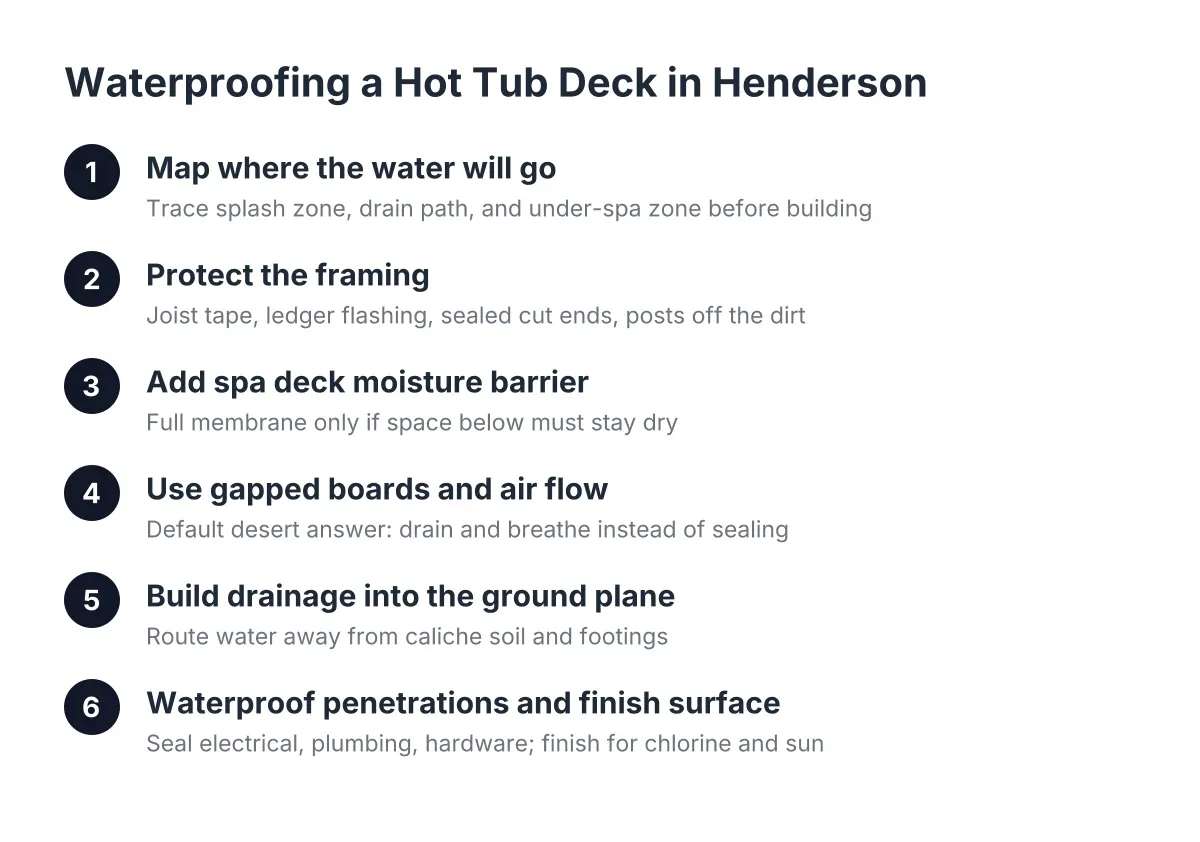
Step 1: Map Where the Water Will Actually Go
Before you buy a single membrane or flashing roll, stand where the spa will sit and trace the water. Splash-out lands in a ring around the tub, usually a few feet wide on the entry side. Drain water, hundreds of gallons of it a few times a year, has to exit somewhere. Filter rinse water and cover runoff add smaller but constant moisture.
Sketch three zones on your deck plan:
- The splash zone: the decking and framing within arm's reach of the spa rim, hit constantly.
- The drain path: where water travels when you empty the tub, from the drain valve to wherever it leaves your yard.
- The under-spa zone: the area directly beneath the tub, which stays shaded, traps humidity, and never dries as fast as the rest of the deck.
In Henderson's established subdivisions, drain water is a bigger deal than most owners expect. Caliche layers under many Green Valley-era yards do not absorb water quickly. Dump a full spa onto hardpan and it can sit, migrate toward footings, or run toward the house. Plan the exit route now, not after the first drain.
Step 2: Protect the Framing Before the Decking Goes Down
Waterproofing starts at the frame, because that is what fails first. Decking boards are replaceable; a rotted beam under a full spa is a structural problem. If you are doing a new hot tub deck installation, this step is cheap and easy. If you are retrofitting a spa onto an existing deck, it means pulling boards in the splash zone, which is worth the labor.
Work through the frame in this order:
- Cap every joist and beam top in the splash and under-spa zones with joist tape. Butyl-based flashing tape seals the screw penetrations where water normally enters end grain. Buy tape rated for high heat; some asphalt-based products soften and ooze on surfaces that hit extreme summer temperatures here.
- Flash the ledger if the deck attaches to the house. Splash water running down the wall behind a spa is a classic path into the rim joist of the home itself. Metal or membrane flashing, lapped correctly so water sheds outward, is non-negotiable.
- Seal cut ends and notches. Any place framing was cut exposes untreated wood core. Coat cuts with an end-grain preservative before covering them.
- Keep framing off the dirt. Posts should land on footings with standoff bases, never buried in soil where drain water will pool against them.
Composite decking does not change this step. The boards may shrug off water, but most composite decks in the valley still ride on pressure-treated wood frames, and that frame needs the same protection.
Step 3: Spa Deck Moisture Barrier and Surface Waterproofing
Here is where desert logic diverges from the articles written for wet climates. You have three main options, and the right one depends on whether anything lives under the deck.
When a Spa Deck Moisture Barrier Requires a Full Membrane
A full waterproofing membrane under a hot tub deck is only necessary when you need the space below to stay dry, such as a walkout area, storage, or a lower patio on a multi-level deck. In that case, an under-deck drainage membrane or trough system catches water between joists and channels it to a gutter. For a low deck over bare dirt, a membrane is usually overkill and can trap moisture instead of shedding it.
Membranes have a desert-specific weakness worth knowing. UV exposure and heat cycling degrade some sheet products faster here than manufacturers' wet-climate testing suggests. If you go this route, pick a system rated for high UV and heat, and make sure it is fully shaded by the decking above.
Therefore, be honest about what you are protecting. Suppose a homeowner in a Henderson master-planned community is building a raised spa deck with a shaded seating area below it. That deck earns a drainage membrane. A spa deck sitting a foot off grade over gravel does not.
Gapped Boards and Air Flow: The Default Desert Answer
For most low and mid-height spa decks here, the best moisture strategy is controlled drainage, not a sealed surface. Proper board gapping lets splash water fall through fast. Open sides or vented skirting let desert air do what it does best, which is dry things out. A deck that drains and breathes will outlast a deck that tries to stay sealed.
The under-spa zone is the exception. The tub shades it permanently, so it dries slowly even in July. That is why the joist tape in Step 2 matters most there, and why some builders set the spa on its own concrete pad with the deck built around it, keeping standing moisture off the framing entirely.
Step 4: Build Drainage Into the Ground Plane
Water that falls through the deck still has to go somewhere. In Henderson soil, "somewhere" will not be straight down. Caliche and compacted desert soils drain slowly, and water that cannot soak in moves sideways toward the lowest point, which is often a footing or the house foundation.
Handle the ground under and around the spa deck like this:
- Grade the soil under the deck away from the house and away from footings before the deck is framed. A gentle slope toward a yard drain or open landscape area is enough.
- Lay a weed barrier topped with gravel under the deck. Gravel will not make hardpan absorb water, but it keeps splash from turning the under-deck zone into mud and speeds evaporation.
- Give drain water a dedicated route. A simple solution is a hose adapter on the spa drain run out to a landscape drain or a planted area that can take the volume. Check local rules on where spa water can legally discharge before you drain; chlorinated water often cannot go to the street or storm drain.
In addition, keep irrigation lines and emitters away from footings near the spa. The slow leak from a cracked drip line does more long-term damage to deck posts than any amount of splash-out.
Step 5: Waterproof the Penetrations: Electrical, Plumbing, and Hardware
Every hole through the deck is a future leak path, and a spa deck has more holes than a plain one. The electrical run to the spa disconnect, any conduit routed under the deck, and the hardware anchoring railing posts near the splash zone all need attention.
First, coordinate the electrical rough-in before the decking goes down, not after. A licensed electrician handles the spa circuit itself, and the code requirements for disconnect placement and GFCI protection are strict; this is one part of hot tub deck waterproofing and safety you should not improvise. Your job on the deck side is making sure conduit penetrations through decking or skirting are sealed and sloped so water sheds away from them.
Next, treat railing posts and spa step anchors in the splash zone like roof penetrations. Flash or tape under the base plates, and use exterior-rated sealant around fasteners. Stainless or coated hardware resists the chlorinated splash that corrodes standard galvanized fasteners surprisingly fast.
Step 6: Finish the Surface for Chlorine, Sun, and Wet Feet
The final layer is the walking surface itself, and spa water is harder on it than rain. Chlorinated or bromine-treated splash bleaches wood finishes and can discolor some composites over time. Combine that with Henderson UV and you have the fastest finish-failure zone on the whole deck.
For wood decking, use a penetrating, UV-rated sealer in the splash zone and plan to recoat that area more often than the rest of the deck, likely every year or two. For composite, choose a board with a dense capped surface; the cap is what resists chemical staining. Lighter colors also run cooler underfoot, which matters when bare feet cross from a hot deck into a hot tub in August.
Slip resistance belongs in this step too. Water plus smooth decking equals falls, and the spa entry point stays wet whenever the tub is in use. Textured boards or an inset of grooved decking at the entry side solves it without turning the whole deck into sandpaper.
Step 7: Set a Simple Maintenance Rhythm
Waterproofing is not a one-time install; it is a system you check. The good news is the desert makes inspection easy, because problems announce themselves as staining, cupping, or white mineral residue rather than hiding under moss.
Twice a year, do a short walkthrough:
- Look under the deck at the under-spa zone for dark staining on joists or tape edges lifting.
- Check sealant around conduit and railing penetrations for cracking; heat cycling splits sealant here faster than in mild climates.
- Confirm the drain path still flows and that landscaping changes have not redirected water toward footings.
- Rinse mineral and chemical residue off the splash zone; hard water deposits hold moisture against finishes.
One honest trade-off: if you are putting a spa on an existing deck that was not built for one, waterproofing is the second conversation, not the first. Load capacity comes first, and that assessment belongs with a deck builder or structural engineer who can open up the framing and verify it. No amount of membrane fixes an undersized beam.
Hot tub deck waterproofing in Henderson comes down to a short list: protect the frame with tape and flashing, let the surface drain and breathe, give drain water a planned exit over slow-draining soil, and seal every penetration. Do those four things during construction and your spa deck will handle a decade of cannonballs, drain days, and desert summers without the soft spots that end most spa decks early.
If you need deck construction, Henderson Deck Co can help.
Prefer to talk it through? Call (725) 425-5179 — a quick call is usually the fastest way to get a straight answer for your situation.