Deck Vs Patio Cover Terms Explained: A Plain-English Glossary
If you are comparing quotes for a deck, a patio cover, or both in Henderson, the paperwork comes loaded with trade terms nobody explains. This deck vs patio cover glossary breaks down the words a deck builder, a general contractor, or your HOA will throw at you, in plain English. Use it to read a quote line by line, ask sharper questions, and spot a vague bid before you sign anything. Every entry is written to make sense on its own, in under thirty seconds.
- Deck: a raised platform, usually wood or composite
- Patio Cover: a roof structure over an outdoor space
- Covered Patio: patio plus permanent overhead shade
- Awning: lighter, often retractable shade attachment
- Pergola: open-slat overhead structure, partial shade
- Composite Decking: wood-plastic boards that resist fade
- PVC Decking: all-plastic boards, no wood content
- Heat-Reflective Decking: boards made to stay cooler underfoot
- Footing: the concrete base that carries the structure
- Caliche: hard desert soil layer that complicates digging
- Ledger Board: the piece that ties a deck to your house
- Joists: the framing boards under the deck surface
- Deck Railing: the code-driven barrier around a raised deck
- Permit: official approval before construction starts
- HOA Design Review: your community's sign-off on the look
- Attached vs Freestanding: whether the structure ties to the house
- Load Rating: how much weight the structure is built to hold
- Resurfacing: new deck boards over sound existing framing
The Structures Themselves
Before you can compare bids, you need the basic terms: what each structure actually is, because contractors use these words loosely and quotes get confusing fast. This deck vs patio cover glossary section breaks down the key categories.
What Defines a Deck vs Patio Cover
A deck is a raised outdoor platform, built from wood, composite, or PVC boards over a wood or steel frame. It sits above the ground on posts and footings instead of resting directly on it. Decks give you usable floor space, which matters in Henderson backyards built on slopes or around pools and hot tubs. If a quote says "deck," ask what it stands on and what the surface boards are made of; those two answers drive most of the cost.
Patio Cover Structures and Their Role
A patio cover is a roof structure built over an outdoor space to block sun and weather, with no walls. It can attach to your house or stand on its own posts. In the Mojave, a patio cover is often the difference between a patio you use all summer and one you avoid until October. The deck vs patio cover shade decisions often come down to whether you need new floor space or shade over space you already have.
Covered Patio
A covered patio is a ground-level patio with a permanent roof structure built over it. It combines a hard surface, usually concrete or pavers, with overhead shade in one project. Builders sometimes quote the slab and the cover as separate line items, so check whether your bid includes both. Our page on covered patio construction walks through how the two pieces fit together.
Awning
An awning is a lighter shade attachment, often fabric or aluminum, mounted to the house wall above a door, window, or patio. Many awnings retract, so you can pull shade out in summer and tuck it away. Awnings cost less than a full patio cover but carry less structure, so desert wind and UV exposure shorten their working life. A builder quoting an awning instead of a cover is quoting a different product, not a cheaper version of the same one.
Pergola
A pergola is an open-top overhead structure with spaced beams or slats instead of a solid roof. It filters sunlight rather than blocking it, so you get pattern shade, not full shade. In Henderson's summer heat, a pergola alone rarely makes a patio comfortable at midday, though it works well as a design feature or with added shade panels. If a bid says "pergola" where you expected a solid cover, that is a scope difference worth flagging.
Materials That Survive the Desert
Composite Decking
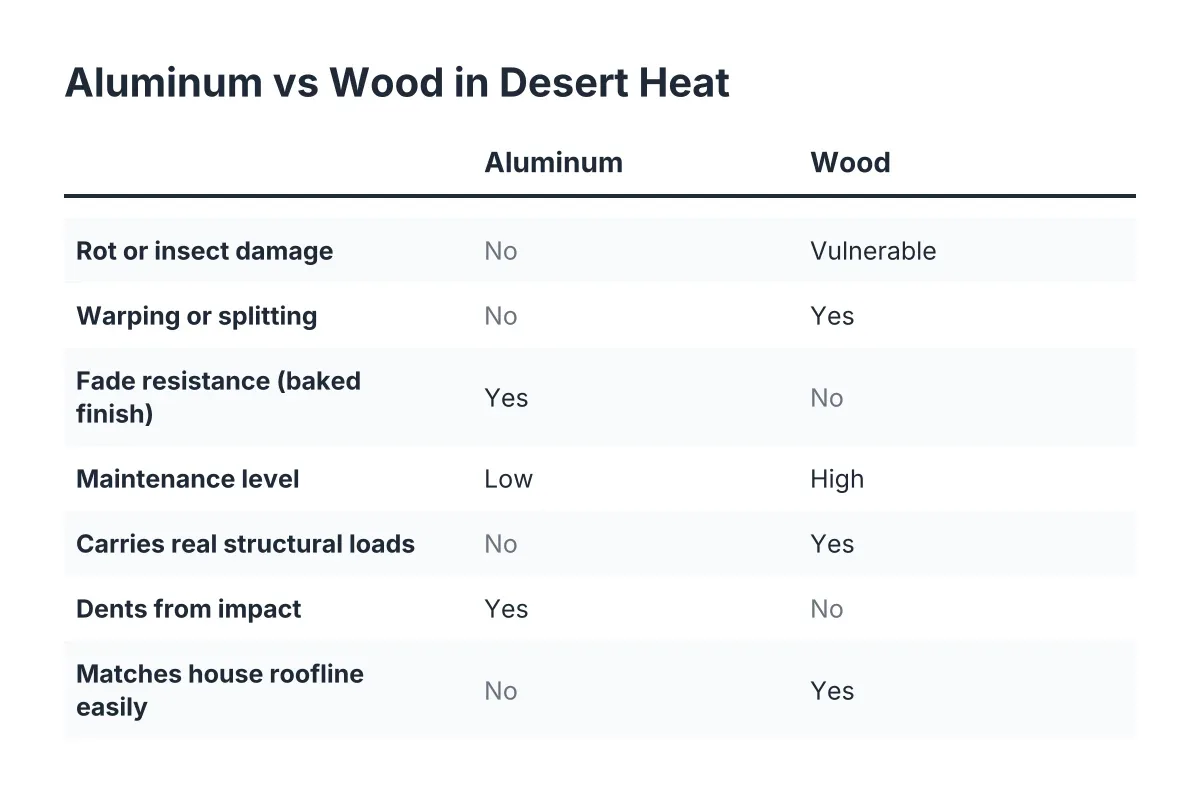
Composite decking is a board made from a blend of wood fibers and plastic, designed to resist rot, splintering, and fading. It costs more upfront than pressure-treated wood but needs no staining or sealing. In the Las Vegas Valley, UV fade is the real enemy, and better composite lines hold their color longer under relentless sun. When a deck builder specifies composite, ask which product line, because performance varies.
PVC Decking
PVC decking is a board made entirely of plastic, with no wood content at all. Because there is no wood fiber to absorb moisture or feed mold, PVC handles pool splash and hot tub overflow better than most materials. It usually sits at the top of the decking price range. For a pool deck or hot tub deck in a Henderson backyard, PVC is often worth the conversation.
Heat-Reflective Decking
Heat-reflective decking means boards engineered with lighter colors or special caps that absorb less heat from direct sun. On a summer afternoon here, deck surfaces get hot enough to matter for bare feet and pets. Darker boards run hotter than lighter ones, period. A builder who brings up surface temperature without being asked is thinking about how you will actually live on the deck, not just how it photographs.
Resurfacing
Resurfacing means replacing the walking surface of a deck, the boards and sometimes the railing, while keeping the existing frame underneath. It is the middle option between repair and full rebuild, and it only makes sense if the framing and footings are still sound. A careful deck builder inspects the structure before quoting a resurface. If someone quotes it without looking underneath, be skeptical.
Under the Surface: Structure and Framing
Footing
A footing is the concrete base, set below ground, that carries the weight of a deck or patio cover down into the soil. Footings are the part you never see and the part that fails worst when done wrong. Desert soil behaves differently than soil in wetter climates, so footing depth and design should reflect local ground conditions. Any quote for a raised deck or a post-supported cover should spell out the footings.
Caliche
Caliche is a hard, cement-like layer of mineral-bound soil common in desert ground, including around Henderson. Hitting caliche during footing excavation can turn a quick dig into a slow one that needs heavier equipment. Experienced local builders expect it and account for it; crews from wetter regions often do not. If your contract has a clause about difficult excavation, this is usually why.
Ledger Board
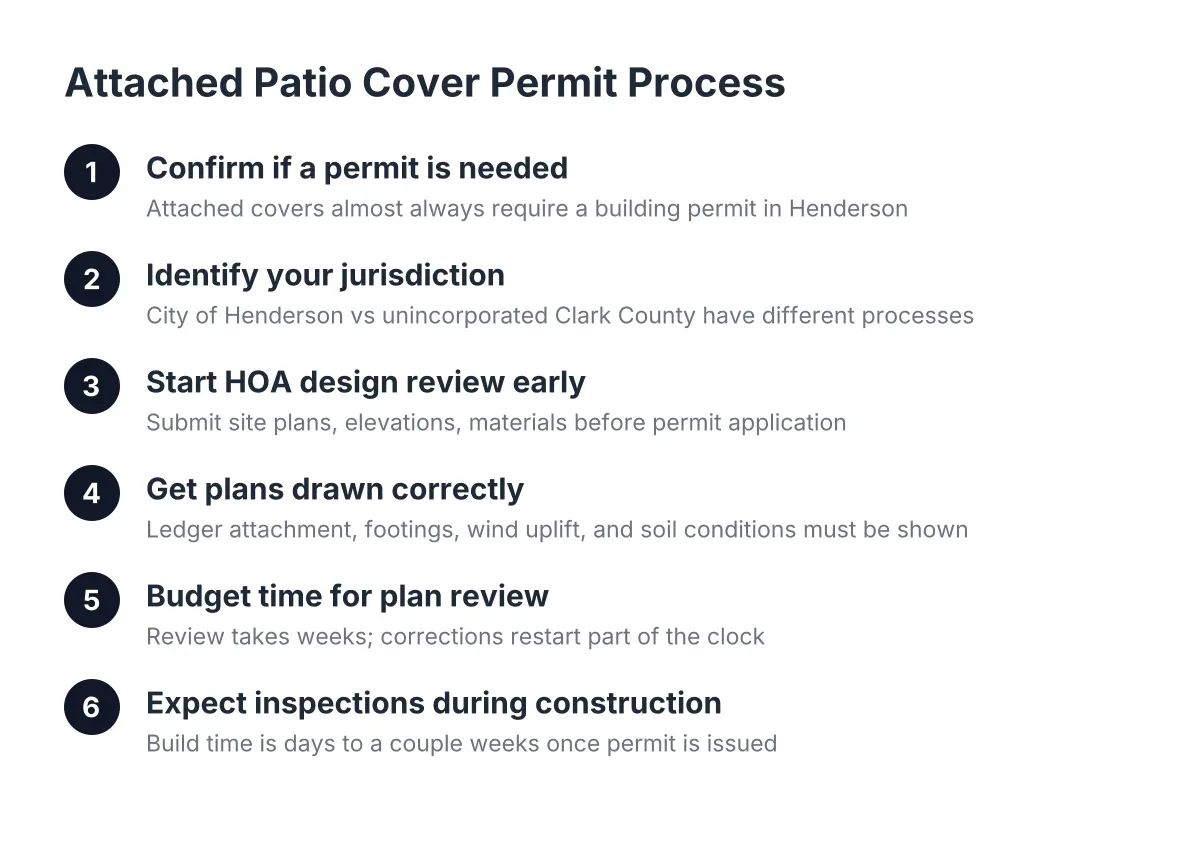
A ledger board is the horizontal board that attaches a deck or an attached patio cover to the house itself. It carries a large share of the structure's weight, so how it fastens and flashes against your wall matters as much as anything in the build. Bad ledger connections are a leading cause of deck failures nationwide. Ask any builder how they attach and waterproof the ledger; a good one answers without hesitating.
Joists
Joists are the parallel framing boards that sit under the deck surface and support the boards you walk on. Their size and spacing determine how solid the deck feels and what decking materials you can use, since some composite and PVC boards require closer joist spacing. When a quote lists joist spacing, that is a sign the builder is matching the frame to the material instead of using one standard layout for everything.
Load Rating
A load rating is the amount of weight a deck or structure is designed to safely support, including people, furniture, and anything heavy on top. It matters most for hot tub decks, because a filled hot tub concentrates serious weight in a small area. A deck addition meant to hold a hot tub needs reinforced framing and footings designed for that load from the start. If you mention a hot tub and the builder does not change the design, keep shopping.
Deck Railing
A deck railing is the barrier built around the edge of a raised deck to keep people from falling off. Building codes typically require railings once a deck rises past a certain height above grade, and they set rules for railing height and the gaps between parts. Railing material, from wood to metal to cable, is one of the bigger style and cost choices on a deck project. It should appear as its own line in any complete quote.
Paperwork, Permits, and Approvals
Permit
A permit is the official approval from your city or county that lets construction legally begin, with inspections along the way. Decks past a certain size or height and most attached patio covers typically need one; check your local requirements, since Henderson and unincorporated Clark County follow different offices. A builder who offers to skip permitting is transferring risk to you, because unpermitted work can complicate insurance claims and home sales. Our guide to attached patio cover permits and HOA approval in Henderson covers the process in detail.
HOA Design Review
HOA design review is the process where your homeowners association approves the look, materials, and placement of your project before you build. Most master-planned communities around Henderson require it for any visible backyard addition, and it runs separately from the city or county permit. Submitting plans, color samples, and a site drawing is standard. Build review time into your schedule, because the HOA works on its own calendar, not your builder's.
Attached vs Freestanding
Attached means the structure ties into your house, usually through a ledger board, while freestanding means it stands on its own posts and footings. The choice affects permitting, cost, and how the structure handles wind and weight. An attached patio cover borrows strength from the house; a freestanding one needs more of its own structure. Deciding between a new deck and overhead shade, the whole deck vs patio cover question, often starts with whether your house wall can carry an attachment at all, and the cost comparison usually follows from there.
Using These Terms
What this deck vs patio cover glossary gives you is the vocabulary to read a bid the way a builder reads it: footings specified, materials named, railing and permits as line items instead of afterthoughts. When a quote skips one of these terms, you now know which question to ask. That is the whole point, fewer surprises between the estimate and the finished backyard.
If you need deck construction, Henderson Deck Co can help.
Prefer to talk it through? Call (725) 425-5179 — a quick call is usually the fastest way to get a straight answer for your situation.