Aluminum Patio Cover Durability in Henderson Heat: An Honest Look From a Deck Builder
Most Henderson homeowners planning a backyard addition ask the same question in a different order. Some start with deck vs covered patio. Others start with materials. Either way, the question underneath is the same: what actually survives out here? Aluminum patio cover durability comes up in almost every conversation about shade structures, and for good reason. The Mojave punishes outdoor structures in ways that articles written for milder climates never mention. This piece walks through how aluminum holds up against desert sun, how it compares to wood and to a deck, and how to think about the choice. We build decks, patio covers, and combinations of both, so we have no reason to push you toward one structure over another.
Why Desert Sun Is the Real Test for Any Backyard Structure
Henderson backyards face a specific set of conditions. Summer surface temperatures climb high enough to make bare concrete and dark decking uncomfortable to touch. UV exposure runs intense for most of the year, which fades stains, chalks paint, and breaks down cheap plastics. Then the soil adds its own complications; much of the valley sits on caliche, a hardened layer that changes how footings get dug and set.
None of this means you should skip a backyard addition. It means the material conversation matters more here than it does in Portland or Nashville. A structure that lasts twenty years in a coastal climate can look tired in five out here if the material was chosen for looks instead of exposure.
For a new-build homeowner in Cadence or Inspirada staring at a bare concrete pad, this is the first real decision. Shade first, or floor first? And if shade, what material earns its cost?
Aluminum Patio Cover Durability: How Well It Withstands Desert Heat
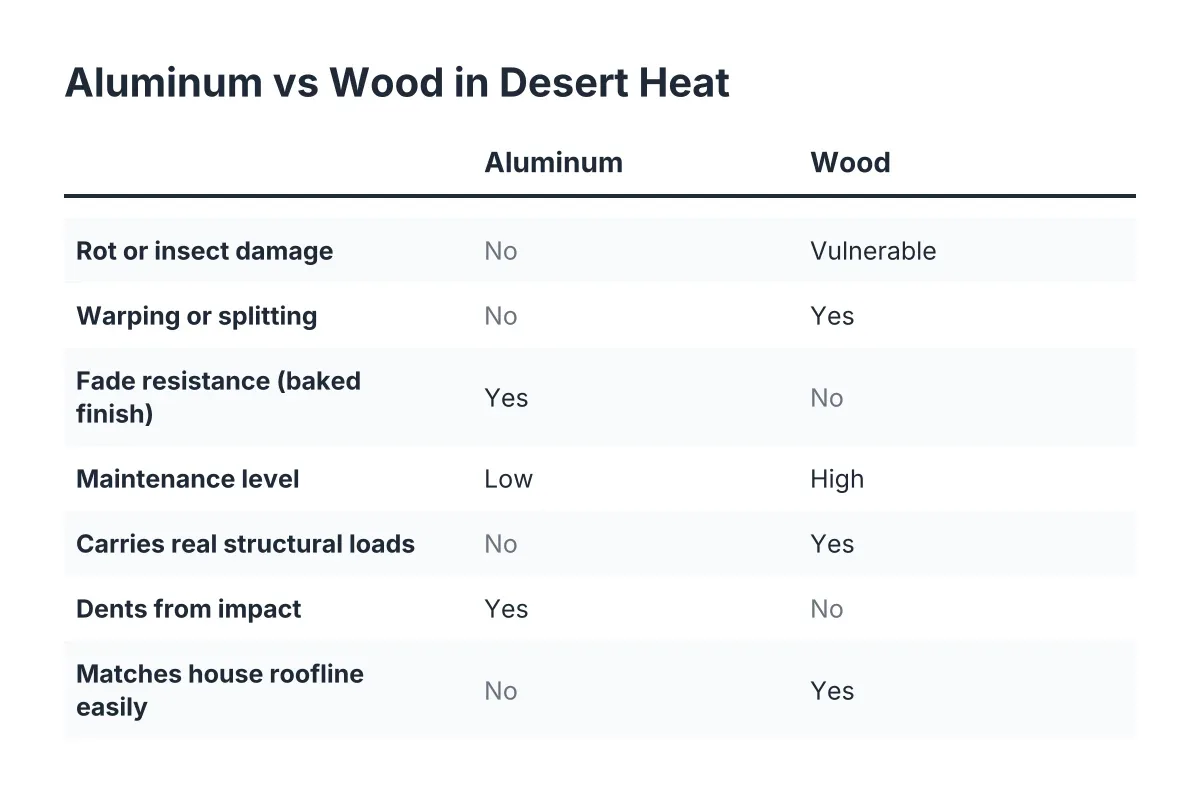
Aluminum patio covers are among the most durable shade structures you can put in a Henderson backyard. Aluminum does not rot, warp, crack, or attract termites, and it will not split under repeated heat cycling the way wood can. With a factory-baked finish, a well-installed aluminum cover routinely outlasts a comparable wood cover in this climate with far less upkeep.
That is the short answer. The longer answer has some nuance worth understanding before you sign a contract.
What Aluminum Handles Well
The desert's biggest threats to outdoor structures are UV radiation, dryness, and heat swings. Aluminum shrugs off most of them.
- No rot or insect damage. There is nothing organic for termites to eat and no moisture pathway for rot, which matters less here than in humid climates but still counts near pool decks and irrigation lines.
- No warping or splitting. Wood posts and beams in full Henderson sun dry out and check over time. Aluminum stays dimensionally stable through summer heat and winter cold snaps.
- Baked-on finishes resist fade. Quality aluminum covers use factory-applied finishes that hold color far longer than site-applied paint or stain on wood. Fade still happens over decades, but slowly.
- Low maintenance. A rinse a few times a year is the typical care routine. Compare that with restaining a wood pergola every two to three years in this UV exposure.
Where Aluminum Falls Short
Honesty matters more than a sales pitch here. Aluminum has real trade-offs.
First, uninsulated aluminum panels radiate heat. A thin, single-skin aluminum roof absorbs sun all day and can radiate warmth down onto the patio below in the evening. Insulated aluminum panels solve most of this; they sandwich a foam core between two skins, which blocks heat transfer and also quiets rain noise. The insulated vs uninsulated choice is one of the biggest quality and comfort decisions in the whole project, and it is where cheaper bids often cut corners.
Second, aluminum dents. A dropped ladder, a heavy monsoon-blown branch, or an aggressive hailstorm can leave marks that wood would absorb better. Dents are cosmetic in most cases, but they are permanent.
Third, weight capacity is limited. If you are wondering how much weight an aluminum patio cover can hold, the practical answer is: enough for ceiling fans, lighting, and misting lines when the structure is engineered for them, but not foot traffic. You should never walk on a standard aluminum patio cover, and it will not support a future second-story deck the way a properly framed structure could.
Finally, style is a matter of taste. Embossed aluminum products mimic wood grain convincingly from a few feet away, but up close some homeowners still prefer the depth of real wood or the clean look of a stucco-wrapped solid cover.
Aluminum Patio Cover vs Wood in the Mojave
The aluminum patio cover vs wood question changes answers depending on where you live. In Henderson, the climate tilts the scales harder than most national comparisons admit.
Wood offers warmth, character, and the ability to carry real structural loads. A wood-framed covered patio can tie into the house roofline, support a future misting system or heavy fans without question, and be stuccoed to match the home. Those are genuine advantages, especially in master-planned communities where HOA design review favors structures that match the house.
However, wood pays a maintenance tax in the desert. UV breaks down stain and sealer fast here. Expect to refinish exposed wood on a recurring cycle, and expect checking and splitting in members that face full afternoon sun. Skip the maintenance and a wood cover starts looking rough within a few seasons.
Aluminum, including the embossed wood-look products many people call Alumawood, flips that equation. You give up some load capacity and some architectural weight, and in exchange you get a structure that mostly just sits there and works. For a homeowner who wants shade without a maintenance calendar, aluminum patio cover durability is the deciding factor more often than price.
There is a middle path worth knowing about. Some projects pair a solid, house-matched cover over the main seating area with an open aluminum lattice section extending over a barbecue zone or spa. Covered patio ideas like this get the durability of aluminum where full shade is not needed and the finished look of an integrated cover where it counts.
Deck vs Patio Cover: They Solve Different Problems
Here is where a lot of Henderson homeowners get stuck, and where the deck vs patio cover framing can mislead you. These two structures are not competitors. One gives you a floor; the other gives you a ceiling. The real question is which problem your backyard has.
A patio cover solves a shade problem. If you already have a usable concrete pad, the pad is not your issue; the sun beating on it from ten in the morning until sunset is. A cover turns unusable afternoon space into livable space, and in this valley that is the higher-impact upgrade for most yards. According to National Association of Home Builders, covered outdoor rooms were the most popular outdoor living feature among design professionals at 73%, ahead of patios at 68% and decks at 55%. The same source reports the Mountain division, which includes Nevada, ranks among the top three regions nationally for patios on new homes at 74% in 2025. The industry has noticed what desert homeowners already know: out here, shade is the amenity.
A deck solves a floor and elevation problem. If your yard slopes, if your back door sits above grade, if you want a defined platform for a hot tub, or if bare dirt is all the builder left you, a deck creates the usable surface itself. Modern composite and PVC decking in lighter, heat-reflective colors handles desert sun far better than the dark boards that made early composites notorious for burning bare feet. Decks also carry strong resale math; the 2025 Zonda Cost vs. Value Report found a wood deck addition recoups 95% of its cost at resale, with composite at 89%.
For example, suppose a homeowner in Cadence closed on a new build last spring with a small concrete pad and a dirt yard. In that scenario, an insulated aluminum patio cover over the pad delivers immediate daily-use value, and a ground-level composite deck can extend the floor space in a later phase once landscaping plans firm up. Sequencing it that way spreads the budget and lets the cover footings and deck framing be planned together instead of retrofitted.
Where Aluminum Patio Cover Durability Changes the Math
Durability is not just a maintenance question; it changes the total cost of ownership and the sequencing of a two-phase backyard.
Consider the lifetime picture as a rough illustration, not a quote. Say a wood cover and an insulated aluminum cover land within a similar installed price range for the same footprint. The wood cover then needs refinishing every few years in this UV exposure, plus eventual repair of checked or split members. The aluminum cover needs a hose. Over fifteen years, the cheaper-looking option is often the aluminum one, even if the initial bids read close.
Durability also affects how a cover pairs with a deck. Because aluminum patio cover durability does not depend on ongoing sealing, you can build the cover first, finish landscaping around it, and add a deck addition or hot tub deck in a second phase without worrying that the cover will need major work in the meantime. A wood structure built first becomes another maintenance item on your list while you save for phase two.
One caveat: durability claims assume competent installation. An aluminum cover attached to the house without proper flashing, or set on posts with undersized footings in caliche-heavy soil, will fail early no matter what the panels are made of. Footing depth, attachment method, and wind rating are engineering questions, and this is a spot where you want a builder or engineer involved rather than a weekend crew with a ladder.
Permits, HOAs, and the Parts of Durability Nobody Advertises
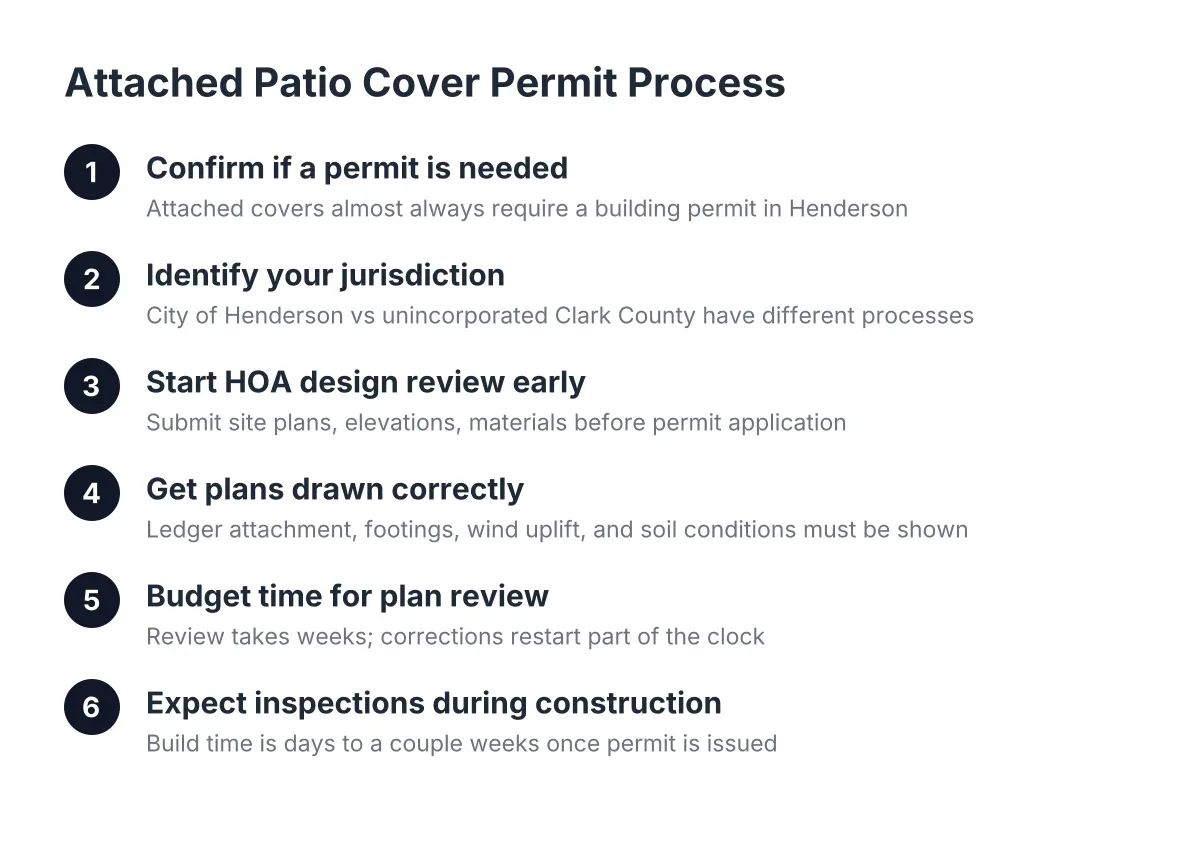
A structure that gets red-tagged or ordered modified is not durable, whatever it is made of. In Henderson, patio covers and decks above certain sizes and heights typically require a permit, and attached structures involve review of how they tie into the house. Clark County and the City of Henderson each have their own paths depending on where your parcel sits.
In addition, master-planned communities like Inspirada and Cadence run HOA design review before you build. Color, height, roofing material, and visibility from neighboring lots all come into play. Wood-look aluminum products exist in part because HOAs often want covers that read as an extension of the house, not a bolt-on carport. Plan for the review timeline in your project schedule; approvals are a process, not a formality, and outcomes vary by community.
None of this should scare you off. It is simply part of what separates a cover that lasts twenty years from one that becomes a problem. A local deck builder who works these permit paths regularly will fold this into the plan from the first conversation.
How to Choose
Strip away the marketing and the decision usually comes down to four questions.
- What problem does your yard actually have? No shade means a patio cover leads. No usable floor means a deck leads. Both problems mean plan a combination from the start, even if you build in phases.
- How much maintenance will you honestly do? If restaining wood every couple of years sounds fine, wood stays on the table. If not, aluminum patio cover durability makes it the practical pick for shade in this climate.
- Does anything heavy need to hang or sit on it? Fans and lights work on engineered aluminum. Anything structural, walkable, or unusually heavy points toward a wood or steel-framed cover, or a deck designed for the load, such as a hot tub deck.
- What will your HOA and permit path allow? Check design guidelines before falling in love with any patio cover ideas from out-of-state photos. Desert-ready outdoor patio cover ideas start with what your community will approve.
There is no single right answer, and any builder who tells you there is has usually stopped listening. The right structure is the one matched to your yard's problem, your maintenance tolerance, and your budget over the next fifteen years, not just the install price. Get those three things straight and the deck-or-cover question tends to answer itself.
If you need deck construction, Henderson Deck Co can help.
Prefer to talk it through? Call (725) 425-5179 — a quick call is usually the fastest way to get a straight answer for your situation.