Best Deck Materials for Henderson Heat: 8 Options Compared for Desert Sun
If your deck is cracking, fading, and splintering after years of Mojave sun, the desert deck materials you choose next matter more than anything else about the rebuild. This guide compares the best deck materials Henderson homeowners can choose in 2026, ranked by how each one handles the two things that destroy decks here: surface heat and UV exposure. No call required, no sales pitch, just the tradeoffs a deck builder weighs on every Henderson job.
Quick context before the list. Henderson decks fail differently than decks in Portland or Michigan. Moisture rot is rare here. Instead, UV radiation breaks down wood fibers and plastic pigments, and summer surface temperatures make some materials too hot to walk on barefoot. A material that tops a national ranking can be a poor fit for a backyard in Green Valley. Here is how the main options stack up for desert conditions.
1. Capped Composite: The Default Pick for Henderson Backyards
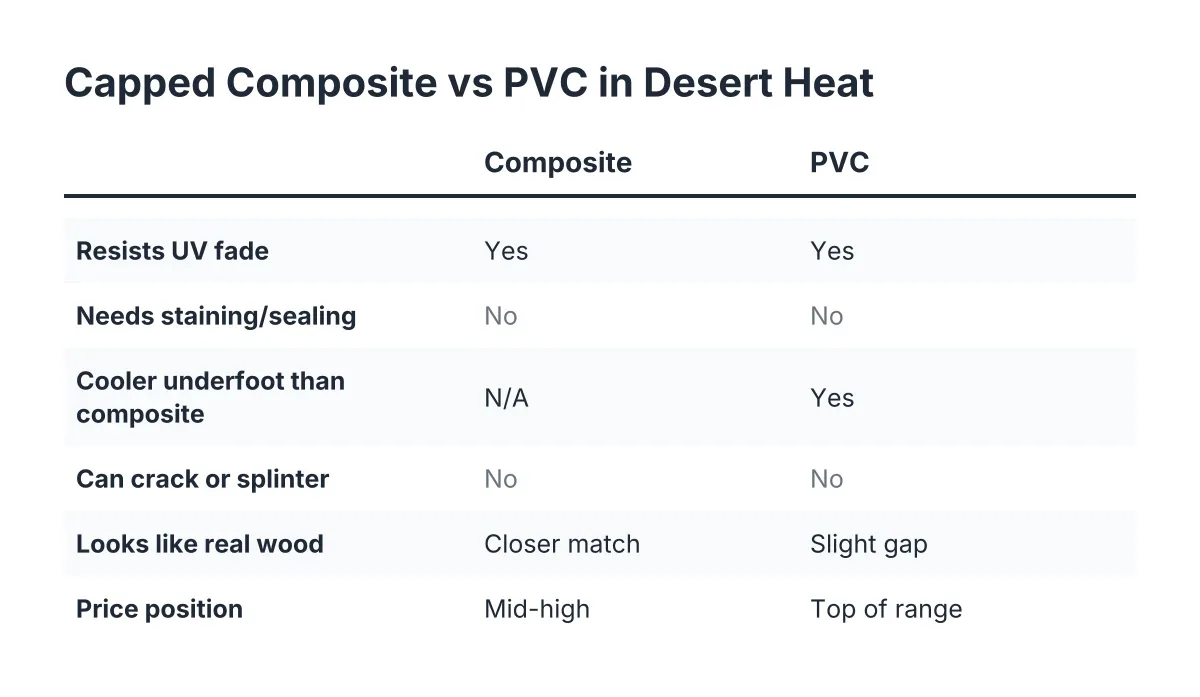
Capped composite decking is the material most Henderson homeowners end up choosing, and for good reason. It wraps a wood-plastic core in a protective polymer shell that resists UV fade far better than bare wood or older uncapped composite. It never needs staining or sealing, which matters in a climate that destroys stain finishes in a season or two.
The tradeoffs are heat and cost. Dark composite boards get uncomfortably hot in direct July sun, so in Henderson we steer homeowners toward lighter colors and heat-mitigating lines some manufacturers now offer. Composite also costs more upfront than wood, though you skip the refinishing cycle that wood demands here every year or two.
2. PVC Decking: The Heat and Fade Champion, at a Price
PVC decking contains no wood fiber at all, which makes it the most stable material in extreme UV exposure. It will not crack, splinter, or rot, and quality PVC lines hold their color longer than most composites. Many PVC boards also run cooler underfoot than composite of the same shade, which is a real advantage around a pool deck, and these synthetic materials are among the most durable desert deck materials available for high-sun applications.
The downside is cost; PVC typically sits at the top of the decking price range. Some homeowners also find it looks slightly less like real wood than premium composite, though the gap has narrowed. If your current deck failed from sun damage and you never want to think about it again, PVC is the strongest answer.
3. Pressure-Treated Pine: Cheapest Upfront, Hardest Worked in the Desert
Pressure-treated pine is the budget option, and it remains the most common framing material even under composite decks. As a walking surface in Henderson, though, it works hard. Intense UV and big day-to-night temperature swings cause checking, cupping, and splintering faster than in milder climates. That splintering is usually what brings sun-damaged deck owners to us in the first place.
Treated pine can still make sense for a shaded deck under a patio cover, or when the budget simply will not stretch to composite. Plan on sealing or staining regularly, and accept that boards will need replacement sooner than the framing underneath them.
4. Redwood and Cedar: Beautiful, but the Sun Collects Its Fee
Redwood and cedar offer natural beauty and stay cooler underfoot than most synthetic boards, which is a genuine plus in our summers. Their natural oils give some resistance to decay, though decay is not the main enemy here.
UV is. Without diligent sealing, both woods gray out fast in desert sun, and the dry heat pulls moisture from the boards until they check and crack. There is one financial argument in wood's favor: in the 2025 Zonda Cost vs. Value Report, a wood deck addition recoups 95% of its cost at resale, compared to 89% for composite. If you are prepping a home for sale and want curb appeal on a budget, wood can be the pragmatic call.
5. Aluminum Decking: Niche, Durable, and Cooler Than You'd Expect
Aluminum decking sounds like a heat trap, but powder-coated aluminum boards shed heat quickly and will not fade, crack, or burn. It is one of the few surfaces that genuinely shrugs off decades of desert exposure.
However, it costs about as much as premium PVC, color options are limited, and it can feel and sound industrial underfoot. We see it most on second-story decks where homeowners want a watertight dry space below, or on hot tub decks where rot resistance and load capacity both matter.
6. Tile or Pavers Over a Structural Deck: Patio Looks, Deck Flexibility
Porcelain tile or concrete pavers installed over a properly engineered deck frame give you a patio-style surface with the elevation and layout freedom of a deck. Light-colored porcelain handles sun exposure well and stays reasonable underfoot compared to dark composite.
This approach costs more because the frame must carry extra weight, and it needs a builder who understands structural loads, not just surface installation. It shines in Henderson backyards built around a pool, where homeowners want the deck to read as one continuous outdoor living space with the existing concrete.
What Makes Desert Deck Materials the Best Choice in Henderson Different From National Rankings
The best deck materials in Henderson are the ones rated for surface heat, UV stability, and expansion in big temperature swings, not the ones that top national lists built around rain and rot. A board that wins a wet-climate test can fade, warp, or overheat here. Evaluate every material against desert criteria first.
When you compare options, judge each one on four Henderson-specific questions:
- Surface temperature: Can you walk on it barefoot in August, especially near a pool?
- UV fade: Does the manufacturer warranty cover fade and color change, and for how long?
- Movement: How much does the board expand and contract between a cold desert night and a 110-degree afternoon?
- Maintenance in dry heat: Will the finish survive our sun, or are you signing up for yearly sealing?
Color matters as much as material. Across every category, lighter boards run cooler. A light gray or sand-tone composite can feel dramatically different underfoot than the same product in espresso brown. If your backyard gets full western sun with no patio cover, color choice is not cosmetic; it decides whether the deck gets used in summer.
Repair, Resurface, or Rebuild: Where Material Choice Enters the Decision
If your existing deck is sun-beaten, you may not need to start over. The honest sequence is to check the frame first. Desert sun destroys deck boards and railings long before it compromises joists and beams, because the framing sits in shade under the surface.
For example, suppose a homeowner in a Green Valley subdivision has a fifteen-year-old pine deck with splintered boards and a wobbly railing. If an inspection finds the joists and footings sound, resurfacing with new composite boards and a new deck railing can deliver most of the benefit of a rebuild at a meaningfully lower cost. In that scenario, the old frame keeps working and only the sun-exposed parts get replaced.
Rebuilding makes sense when the frame itself has problems: undersized footings, corroded fasteners, or joists that were never designed for the heavier loads of composite, tile, or a hot tub deck. A material upgrade can also force a rebuild on its own; composite and PVC often require tighter joist spacing than the original wood deck had. A qualified deck builder should walk the frame with you and show you what they find before quoting either path. If a railing moves under hand pressure or a board has given way underfoot, get the structure inspected before anyone stands on it again.
How Material Choice Drives Deck Construction Cost in Henderson
Decking material is one of the biggest levers on deck construction cost, but it is not the only one. Size, elevation, railing length, and whether you add a patio cover all move the number. In a typical project budget, the boards themselves are a large line item, yet labor, framing, and footings in our caliche-heavy soil carry real weight too.
Think of it this way. Moving from treated pine to mid-range composite raises material cost but removes the staining and board-replacement cycle. Moving from composite to PVC or aluminum raises it again, in exchange for the longest service life in full sun. There is no invented magic number here; the right spend depends on how long you plan to stay and how the backyard gets used. A homeowner planning to host grandkids around a pool for the next twenty years makes a different call than one listing the house next spring.
Demand for this kind of backyard addition is not a fad, either. According to the National Association of Home Builders, the Mountain region that includes Nevada ranks among the top three regions nationally for patios on new homes, at 74% in 2025. Established Henderson homes without a usable deck or covered patio are increasingly the exception.
Pair the Material With Shade: Why Patio Covers Change the Math
Shade changes which materials work. A covered patio or patio cover drops surface temperature and blocks the direct UV that fades boards, which means a mid-priced composite under a cover can outlast a premium board in open sun. According to the National Association of Home Builders, covered outdoor rooms were the most popular outdoor living feature among design professionals at 73%, ahead of patios and decks alone.
Therefore, if your budget forces a choice between top-tier PVC in full sun and mid-range composite under an awning or solid patio cover, the covered option often wins on both comfort and longevity. Good deck design ideas for Henderson almost always start with shade, then pick the surface. Deck building in this valley is as much about managing sun as it is about carpentry, and the two decisions should be made together, not in sequence.
A Straight Answer for the Sun-Damaged Deck Owner
If you came here because your boards are splintering and you want the short version, here it is. For most Henderson rebuilds and resurfacing projects in 2026, light-colored capped composite is the practical default. PVC is the upgrade when heat and fade are your top concerns or the deck wraps a pool. Wood is the budget or pre-sale play, with honest maintenance obligations attached. Aluminum and tile-over-frame are specialty answers for second stories, hot tub decks, and patio-integrated designs.
Whatever you pick, judge it against desert criteria, confirm the frame can carry it, and plan shade into the design from day one. Choosing from the best deck materials Henderson conditions allow, rather than what a national chart recommends, is the difference between a deck you replace again in ten years and one you stop thinking about. Material specs and HOA design rules in master-planned communities change, so confirm current product ratings and local requirements with a professional before you commit; that is one area where browsing deck ideas for backyard inspiration online cannot substitute for a site visit.
If you need deck construction, Henderson Deck Co can help.
Prefer to talk it through? Call (725) 425-5179 — a quick call is usually the fastest way to get a straight answer for your situation.